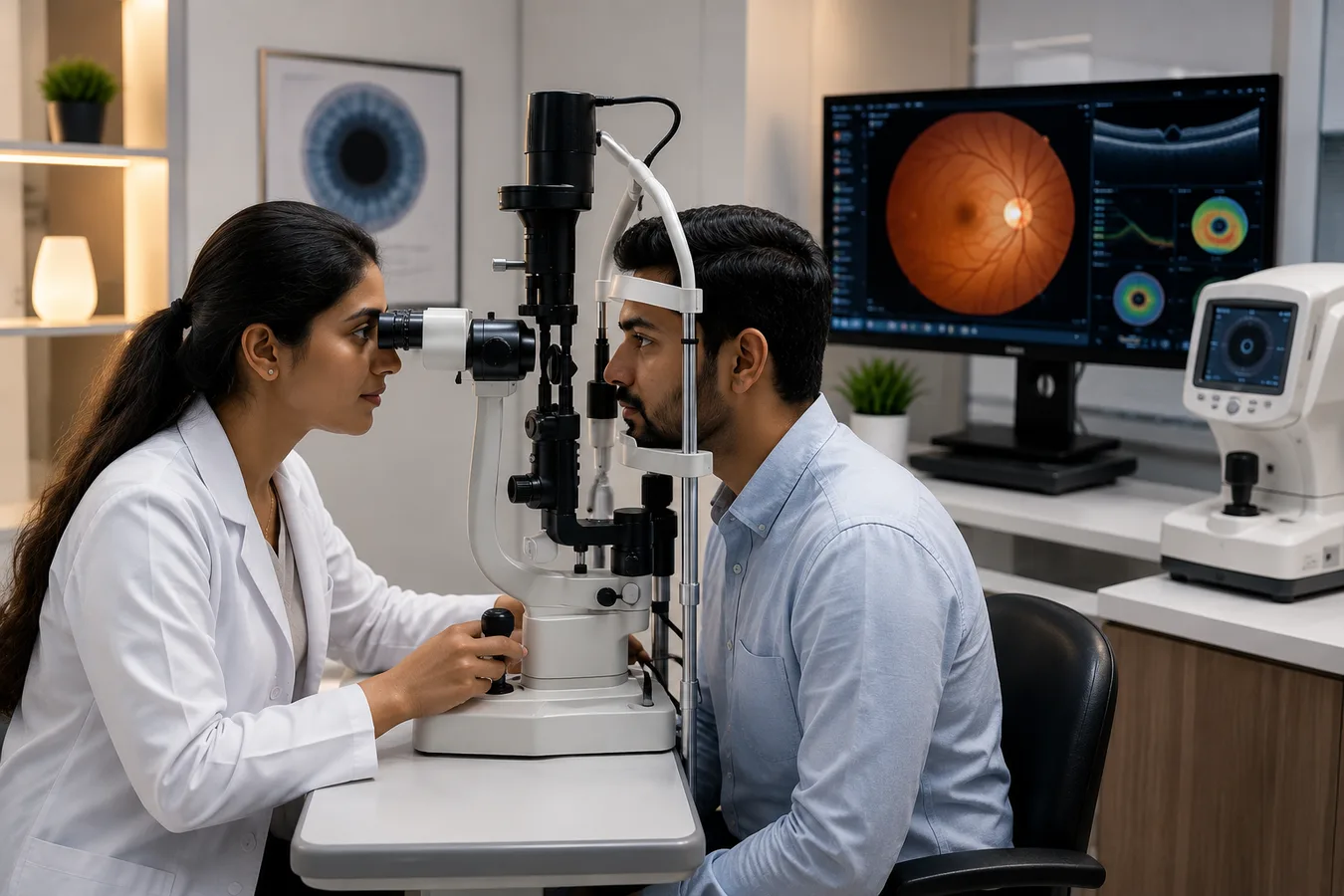

What is it?Refractive surgery changes how the eye focuses light to reduce dependence on spectacles or contact lenses. Options and suitability depend on detailed testing.
Symptoms and warning signs
Arrange an eye examination when you notice symptoms such as:
- Dependence on spectacles or contact lenses
- Difficulty using contact lenses
- Stable refractive error with interest in spectacle reduction
- Lifestyle or professional reasons for considering refractive treatment
Causes and risk factors
- Myopia, hyperopia or astigmatism
- Corneal shape and focusing characteristics
- Age-related near-vision change, which is different from distance refractive error
How diagnosis is made
The examination is tailored to the patient. It may include:
- Accurate refraction
- Corneal examination and thickness or shape assessment
- Dry-eye evaluation
- Pupil and retinal assessment
- Review of prescription stability and medical history
Technology and clinical tools
- Corneal topography or tomography at an appropriate diagnostic centre
- Pachymetry or corneal-thickness assessment
- Wavefront or advanced refractive evaluation when indicated
- Network referral for procedure-specific testing
Specific equipment and procedure availability can vary by centre. SGVEH Champa can help coordinate network-based testing when recommended.
Treatment options
- Spectacles or contact lenses
- LASIK or other laser vision-correction options for suitable patients
- Surface procedures or implant-based options in selected cases
- Continued optical correction when surgery is not advisable
Recovery and follow-up
Typical guidance
Many laser procedures allow functional recovery within days, but dryness, fluctuating vision and light sensitivity can occur. The exact timeline depends on procedure type and individual healing.
Doctor’s advice
Choose refractive treatment only after a complete suitability evaluation. A low-cost offer should never replace corneal safety, realistic counselling and appropriate follow-up.
Patient FAQs
Adults with a stable spectacle prescription may be considered, but age alone is not enough. Corneal and eye-health testing is required.
No. Thin or irregular corneas, unstable power, severe dry eye, pregnancy and certain eye or medical conditions may affect suitability.
Many patients return to routine activities within days, but visual stability and dryness can take longer. Recovery differs by procedure.
Cost depends on the procedure and technology selected after suitability testing. A meaningful estimate requires evaluation.
LASIK can reduce spectacle dependence, but it cannot guarantee perfect vision for life. Age-related near-vision changes may still occur.